
Build By or Borrow — Part 2
North America moved to T+1 in May 2024. Affirmation jumped. Fail rates barely moved.
Compressing the cycle pushed the work earlier into trade date but left the causes in place, and those causes are mostly inventory and data. On 11 October 2027 the EU, the UK and Switzerland make the same move, with more CSDs, more currencies, tighter windows across time zones and a cash penalty regime that is already running.
Part 2 of the series looks at what a fail really costs, why most of them trace back to data, and why Europe is harder than North America was. For North American firms with European exposure, FX funding shifts onto trade date and custodians will pass penalties down the chain.
Then the practical question. AI can score every trade for fail risk on trade date, check SSIs before they drift, and rank the exception queue by cost. Instructions, recalls, buy-ins and client communications stay with deterministic controls and a human who signs off. Build, buy or borrow? With a date that won't move, the answer depends on your fail rate by root cause.
The model proposes, and the controls dispose.
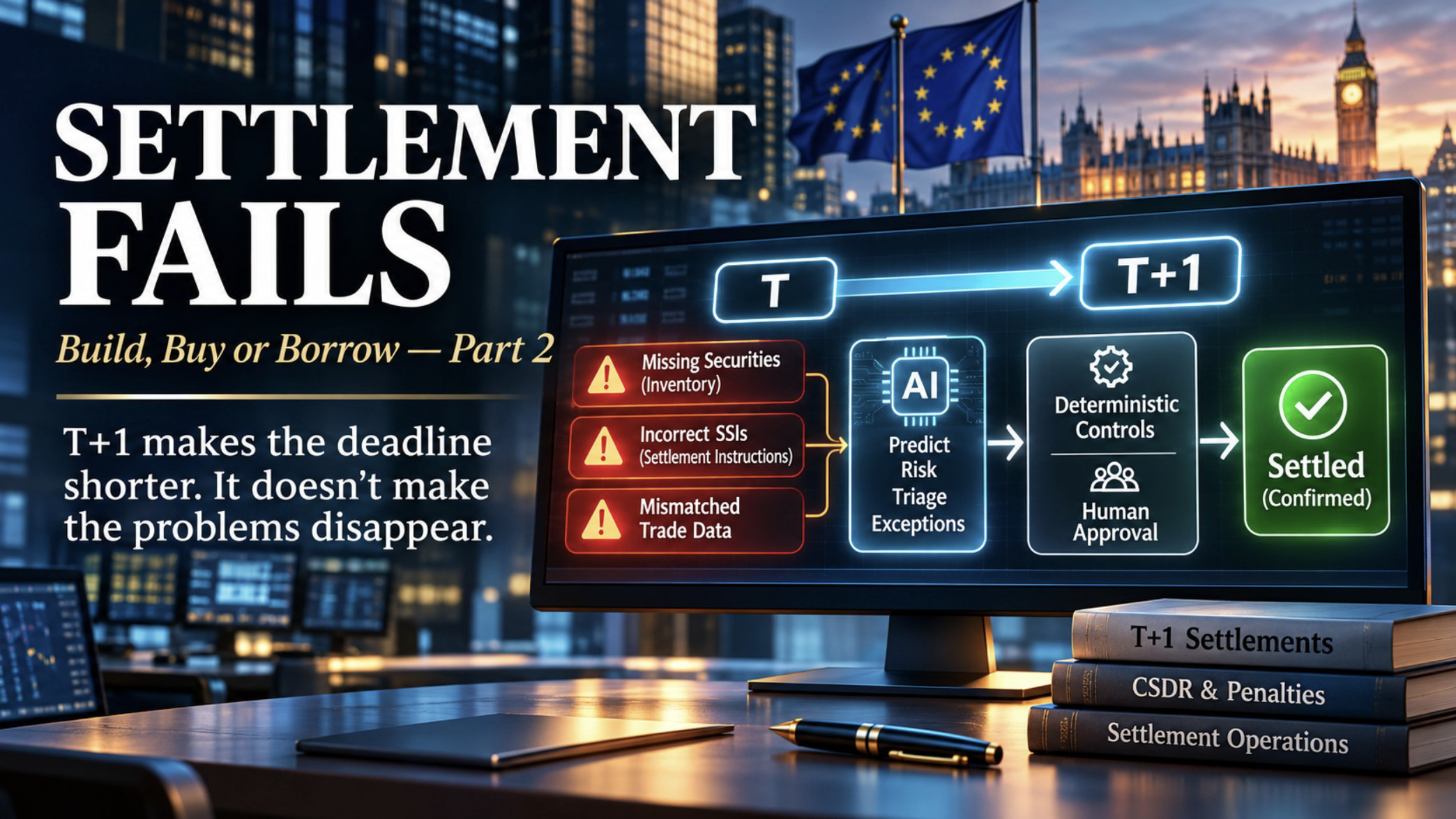
The US and Canadian move to T+1 in May 2024 is called a success, and on affirmation it was. The fail rates remained broadly consistent with the T+2 levels. Compression of settlement dates pushed the work earlier into trade date without removing the causes, which are mostly inventory and data. Europe and the UK go to T+1 on 11 October 2027, which means more CSDs, more currencies, a cash penalty regime that is already running, and tighter windows across time zones. The firms that see a fail coming before it happens will do well, and that means pattern recognition on their own data, wrapped in deterministic controls.
This is Part 2 of the Build, Buy or Borrow series, following on from AI-Augmented Corporate Actions. It shows how a corporate actions event handled badly feeds a bad position, and a bad position feeds a fail.
We got faster at agreeing on a trade. We did not get better at delivering it.
On 11 October 2027, the EU, the UK and Switzerland move to T+1 settlement [1][2][3].
Canada went first, on 27 May 2024. CDS reports that institutional trade processing trended towards its 90% confirmation target and calls the transition "A Triumph of Collaboration". CNS Participant Fund requirements fell by about 27% on a five-day rolling average, and the CNS Default Fund by 23.4%, with CAD settlement fail rates comparable to T+2, typically below 2% [4].
The US followed on 28 May 2024. Affirmation by the 9:00 p.m. trade-date cut-off rose from 73% in January 2024 to nearly 95% afterwards [5][6]. The NSCC Clearing Fund fell by 23% against the prior three-month average, and the CNS fail rate averaged 2.12% in July 2024, consistent with T+2 [5]. DTCC's own monthly data shows fail rates in April 2026 slightly above their pre-T+1 levels [7].
A compressed cycle could have been expected to push fail rates up. That it didn't shows how well the US and Canada prepared. Firms that aren't ready for October 2027 will find new procedures imposed by their back-office providers, and those changes need to be clearly communicated. Smaller firms, such as boutiques or family-operated firms, can be more adversely affected if they have a single, or part-time, person managing their settlements internally.
__________________________________________________________________________________________________________________________________________________________________________________________
What a Fail Actually Costs
A fail has two kinds of cost. The direct ones are penalties, interest claims, buy-ins and the cost of funding a position you expected to have closed. The hidden ones are people chasing exceptions, client friction and the capital held against what hasn't settled. Neither is small.
Firebrand Research estimates that the industry has spent at least USD 914.7 billion over a decade on settlement fail penalties and resolution [8]. For a sense of scale in a single market, the ECB's TARGET2-Securities annual report for 2023 shows T2S participants paid an average of 795,654 cash penalties a month for late matching and settlement fails in euro activity. That is about €70.43 million a month, ranging from €42.06 million in December to €108.70 million in September [9].
Citi reports that inaccurate or outdated SSIs drive 21% of T2S settlement fails [10].
Canada has no comparable published cost figure. CDS reports that T+1 fail rates on CAD settlements have stayed comparable to T+2 levels, typically below 2% [4]. Canada doesn't charge CSDR-style cash penalties on equities, so the cost of a fail shows up in operations budgets, not on an invoice. That is starting to change at the edges. A fail fee for Government of Canada bonds and bills, administered by CDS, is in a trial period: fails and indicative fees are calculated and fail rates published, but no payments change hands yet [11]. Equities sit outside it.
For Canadian firms settling European securities, October 2027 introduces a shorter operating window within an existing European cash-penalty regime. The resulting costs may be passed through custody arrangements, making settlement efficiency a more visible commercial concern.
__________________________________________________________________________________________________________________________________________________________________________________________
Why Fails Happen (and Why Most of It Is Data)
Fails come from two places. The first is inventory: the securities or the cash aren't where they need to be when they need to be there. That is the biggest category. The second is data: wrong SSIs, wrong safekeeping accounts, and trade details that don't match the counterparty's. That is generally more amenable to standardisation and preventive controls.
The regulators and the infrastructure providers agree on this. The FCA, reporting on its readiness work in August 2026, named the most common causes as counterparties being short of stock or failing to deliver it, SSI mismatches, and inventory management problems [12]. It added a pointed observation: well-prepared firms could state their fail rate and its top causes, and some participants could not [12].
Swift's analysis of MT 548 status messages after the US move shows the same split [13]. The top three reasons instructions stayed unmatched were incorrect safekeeping account or agent details, trade data not matching, and settlement amounts not matching. The top three reasons for actual fails were lack of securities, instruction issues, and lack of cash or credit. Swift also identifies continued reliance on manual processing as a root cause.
Shortening the cycle removed neither cause. It took away the extra day in which a broken SSI or a missing position could be caught and fixed quietly.
__________________________________________________________________________________________________________________________________________________________________________________________
October 2027: Why Europe Is Harder
On 11 October 2027 the EU, the UK and Switzerland move together, but they don't move as one market. Europe has many CSDs, several currencies with separate funding cut-offs, and a penalty regime that is already running. There are also new settlement discipline rules. From 7 December 2026, allocations and confirmations between investment firms and their professional clients must use electronic, standardised, machine-readable communication [14][15]. ESMA's position, a year out, is that the regulatory framework is complete and the remaining work belongs to the industry [14].
Time zones are the warning from the US experience. Swift found that APAC-based instructing parties saw a 9% increase in late settlement rates when settling into North America after US T+1. It attributes this to time-zone constraints and liquidity cut-offs [13]. Anyone settling into Europe from Asia or the Americas from October 2027 should take that as a preview.
What this means for North American firms. If you trade European securities, hold European custody, or have European clients, this is your problem as well:
The cycle mismatch disappears, but the time squeeze arrives. Since May 2024, North America has settled on T+1 and Europe on T+2. In October 2027 the cycles align again. North American desks will then be finishing trade-date work in the European evening.
FX moves onto trade date. The EU T+1 Industry Committee recommends that FX trades be dealt, processed and submitted to CLS by 00:00 CET on settlement date [16]. That is about 6 p.m. in New York on trade date. The CLS window itself hasn't moved, and European firms sit comfortably inside it: CLS estimates the change will affect only around 0.4% of its average daily settlement value in the EU and Switzerland, and 0.1% in the UK [17]. The squeeze lands on everyone else. Under US T+1 it hit Asian and European buyers of US securities who needed dollars after the US close. From October 2027 it runs the other way, onto North American and Asian buyers who need euros, sterling and Swiss francs arranged before their own day ends. Not every EEA currency is CLS-eligible either, so some will need funding outside CLS altogether [18].
Custodians will pass penalties on. CSDR penalties fall on CSD participants, and they pass them down the chain. A North American buy-side firm will see them on its custodian invoice whether or not it has ever read CSDR.
Holiday calendars don't line up. US and Canadian holidays differ from TARGET2 and UK holidays, which creates gaps in funding and instructions.
Lending recalls start earlier. European securities on loan will need to be recalled sooner to deliver on time.
__________________________________________________________________________________________________________________________________________________________________________________________
Where AI Genuinely Helps (and Where It Must Stop)
Fails aren't random. A paper in the Journal of Operational Risk, first published in November 2026 for its December 2026 issue, uses transaction-level post-trade data to show that on-time settlement failures can be predicted from observable trade characteristics and the account's own settlement history [19]. The core method is a logistic regression. You don't need a frontier model; you need your own history, kept clean. Prediction is only useful if the firm can act on it before the relevant settlement cut-off; model accuracy alone is not the operational success measure.
That points to four useful jobs:
Scoring every trade on trade date. Estimate how likely it is to fail and the probable cause, while there's still time to act.
Checking SSIs and reference data. Compare every outgoing instruction against the golden SSI source, and flag drift before it becomes a fail. Place-of-settlement and CSD-specific fields on European instructions are where cross-border SSIs drift most.
Triaging exceptions. Read MT 548 status and reason codes, counterparty emails and PDFs. Classify the break, propose the fix, and rank the queue by cost: value, penalty exposure and funding.
Spotting inventory problems early. Flag positions likely to be short on settlement date, from lending recalls, pending receipts or corporate actions, early enough to act. This is where Part 1 links in: an entitlement processed late produces a wrong position, and a wrong position produces a fail.
Two narrower uses earn their place under a penalty regime: reconciling penalties, by matching custodian penalty reports against your own fails and flagging the ones you can dispute, and forecasting FX funding for next-day European currency needs from that day's order flow.
Some things must stay deterministic and human-approved: sending or amending instructions, recalling securities on loan, partial settlement decisions, buy-ins, and anything said to a client about a fail. These can still be automated, but only under authorised rules, mandates and supervisory controls, which rules out probabilistic AI making the call.
The model proposes, and the controls dispose.
Each exception decision should be logged with what the model saw, what it recommended, and who approved it. When a regulator or a client asks why a trade failed and what you did about it, that log is your answer.
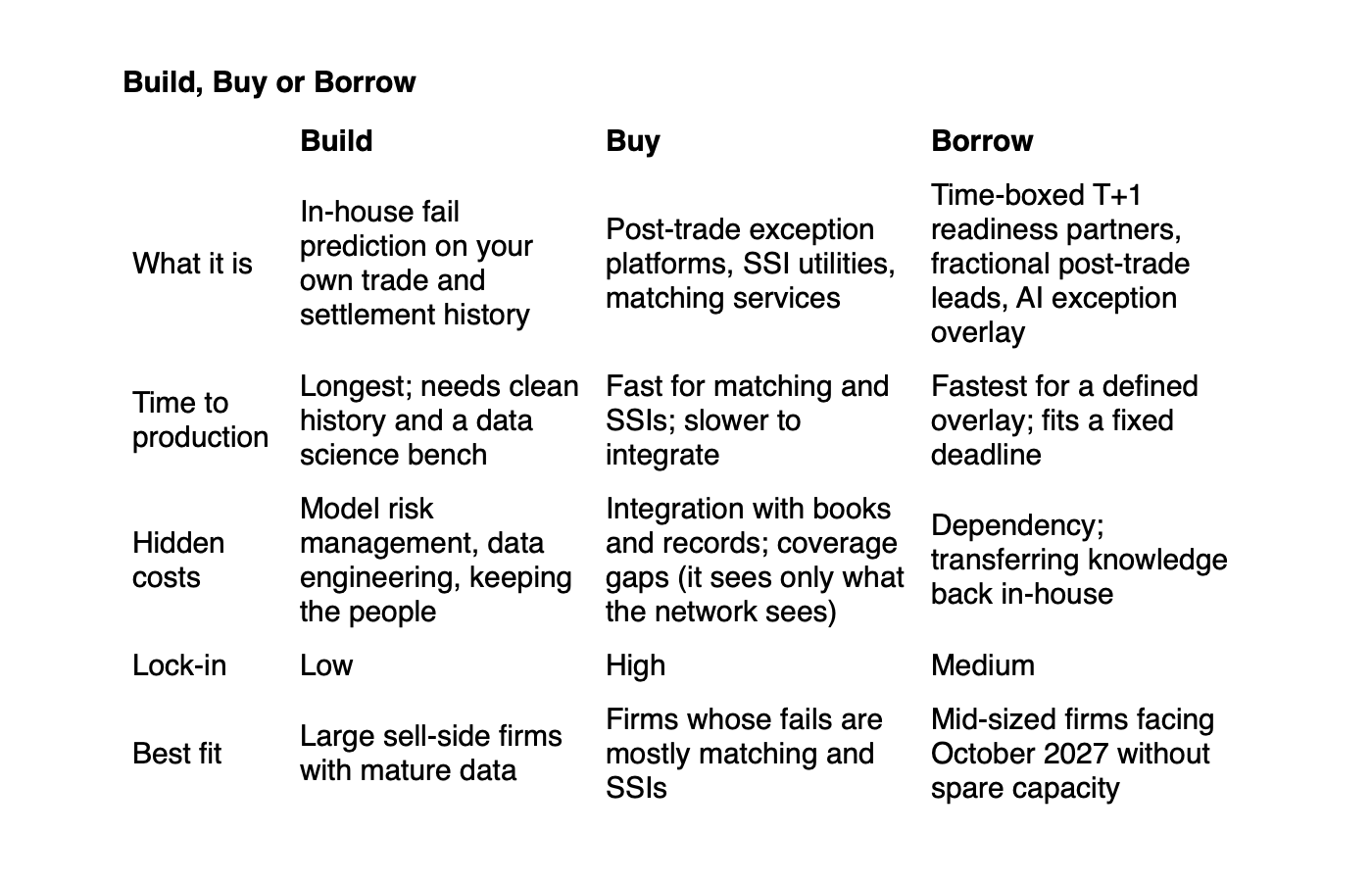
A fixed regulatory date is the classic case for Borrow.
Build rarely finishes in time: the paper above shows the model is the easy part, and the data engineering and model governance around it take the time.
Buy fixes matching but can't see your own inventory blind spots, because a network only sees what passes through it.
Borrow gets a defined overlay running against a date that won't move. Specialist capacity can accelerate a defined remediation programme against a fixed deadline. The condition is that the knowledge comes back in-house afterwards.
That matters most for the firms I described at the start: the boutique or family-run firm with one person, possibly part-time, running settlements. They can't build, they may not justify a platform, and they will still be named when they fail.
As in Part 1, there's a caveat. A large custodian operating in many markets will probably need Buy and Build together. A limited overlay won't be enough for it.
__________________________________________________________________________________________________________________________________________________________________________________________
Governance and Accountability
Penalties and fail reporting name the failing participant, and outsourcing doesn't change that.
Under the EU settlement discipline rules, CSDs report fails to their supervisors not only in aggregate but also by participant, including the ten participants with the highest fail rates [20]. Most of the revised reporting changes apply from 1 July 2027 [21]. In the US, FINRA Regulatory Notice 21-29 makes clear that a firm stays responsible for the functions it outsources (as covered in Part 1 of this series) [22].
The FCA expects firms to know their fail rates and their causes, expects all firms to be testing their T+1 processes during 2027, and has said it may take action against firms that are not adequately prepared [12][23]. In Canada, OSFI Guideline B-10 sets the same principle for federally regulated financial institutions managing third-party risk [24]. For investment dealers, CIRO's guidance on outsourcing arrangements sets out what can be outsourced and how the dealer must manage the risk [25].
Whether you build, buy or borrow, the accountability stays with you.
__________________________________________________________________________________________________________________________________________________________________________________________
Closing
The decision comes down to three questions:
What is your fail rate by root cause? If you can't answer, as some firms couldn't when the FCA asked, start there.
Which markets and CSDs do you touch? Each one adds cut-offs, currencies and penalty exposure.
How much of your exception queue is data, and how much is inventory? Data points to Buy or a Borrowed overlay. Inventory points to Build, or to a partner who can see your books.
We got faster at agreeing on trades. October 2027 will show who got better at delivering them.
CMA places experienced specialists where the problems are, and backs AI-enabled review with people accountable for every decision.
Next in the series: KYC and client onboarding.
__________________________________________________________________________________________________________________________________________________________________________________________
Sources
European Union, Regulation (EU) 2025/2075 amending CSDR to shorten the settlement cycle to T+1, applying from 11 October 2027 (A&O Shearman summary, 14 October 2025). https://finreg.aoshearman.com/Regulation-to-shorten-settlement-cycle-to-T1-publ
HM Treasury, Policy note – Mandating T+1 settlement in the UK, 20 November 2025. https://www.gov.uk/government/publications/accelerated-settlement-t1/policy-note-mandating-t1-settlement-in-the-uk
FCA, About T+1 settlement (UK, EU and Swiss dates). https://www.fca.org.uk/markets/about-t1-settlement
CDS (TMX), T+1 Is Here: Transforming Canadian Capital Markets, undated (accessed November 2026). https://www.cds.ca/solutions/cds-key-initiatives/t-1
SIFMA, ICI and DTCC, T+1 After Action Report, 12 September 2024. https://www.sifma.org/resources/news/press-releases/sifma-ici-and-dtcc-release-t1-after-action-report-industry-coordination-led-to-successful-transition-reducing-risk-and-costs-in-the-system
DTCC, Successful T+1 Implementation in the U.S.: What Insights Can Be Applied to Other Markets?, 26 August 2024. https://www.dtcc.com/dtcc-connection/articles/2024/august/26/what-insights-can-be-applied-to-other-markets
DTCC, Equities by the Numbers (affirmation and fail rates against pre-T+1; April 2026 data). https://www.dtcc.com/equity-trade-volume-insights
Markets Media, "Penalties, Settlement Failure Resolutions Cost $915bn" (Firebrand Research), 1 March 2024. https://www.marketsmedia.com/penalties-settlement-failure-resolutions-cost-915bn
European Central Bank, TARGET2-Securities Annual Report 2023, section 1.5 (penalty mechanism), 2024. https://www.ecb.europa.eu/press/payments-news/ecb.t2sar2023.en.html
Citi, Are your SSIs in place?, 29 September 2026. https://www.citigroup.com/global/insights/are-your-ssis-in-place
Bank of Canada / CIMPA, CIMPA Fail Fee Framework FAQ (Government of Canada bonds and bills; trial period), July 2026. https://www.bankofcanada.ca/wp-content/uploads/2026/08/CIMPA-Fail-Fee-Framework-FAQ-July-2026.pdf
FCA (Jamie Bell), T+1 settlement: are firms ready for 2027?, 6 August 2026 (updated 13 August 2026). https://www.fca.org.uk/news/blogs/t1-settlement-are-firms-ready-2027
Swift, What we're learning along the way (T+1: One year on), 2025. https://www.swift.com/ja/node/310326
ESMA, One year to go for T+1 settlement: the regulatory framework is complete, now let's make it happen, 16 October 2026. https://esma.europa.eu/press-news/esma-news/one-year-go-t1-settlement-regulatory-framework-complete-now-lets-make-it
A&O Shearman, Delegated and Implementing Regulations under CSDR published in OJ (Delegated Regulation (EU) 2026/1536, settlement discipline RTS), 14 October 2026. https://finreg.aoshearman.com/delegated-and-implementing-regulations-under-csdr-published-in-oj
EU T+1 Industry Committee, High Level Roadmap to T+1 Securities Settlement in the EU, June 2025 (FX recommendation: submit to CLS by 00:00 CET on settlement date). https://www.fia.org/sites/default/files/2025-06/High-Level%20Roadmap%20to%20T%2B1%20Securities%20Settlement%20in%20the%20EU_0.pdf
CLS (Marc Bayle de Jessé), T+1 is coming to Europe. Here's why FX firms must pay attention, 2 October 2025. https://www.cls-group.com/news/tplus1-is-coming-to-europe-here-s-why-fx-firms-must-pay-attention
Citi, T+1 Implementation Guide for European markets (FX and liquidity management). https://www.citigroup.com/rcs/citigpa/storage/public/T-1-Implementation-Guide-for-European-markets.pdf
Krimpas, G. A., Krimpas, N. A., Lampropoulos, S. D. and Thanasas, G. L., "Can we predict settlement delays and failures? Transaction-level evidence on liquidity and operational frictions", Journal of Operational Risk 21(4), December 2026, first published 3 November 2026. DOI: 10.21314/JOP.2026.011. https://www.risk.net/node/7964376
Council of the EU, ST 11644/26 ADD 1, Annex to the Commission Delegated Regulation amending the RTS on settlement discipline (Delegated Regulation (EU) 2018/1229), 2026. https://data.consilium.europa.eu/doc/document/ST-11644-2026-ADD-1/en/pdf
Arthur Cox, Getting set for T+1: key changes and compliance dates, 9 November 2026. https://www.arthurcox.com/insights/getting-set-for-t1-key-changes-and-compliance-dates/
FINRA, Regulatory Notice 21-29, Vendor Management and Outsourcing, 13 August 2021. https://www.finra.org/rules-guidance/notices/21-29
FCA, Dear Compliance Officer: FCA expectations for the UK move to T+1 settlement (Asset Management and Alternatives portfolio). https://www.fca.org.uk/publication/correspondence/dear-compliance-officer-fca-expectations-uk-t-plus-1-settlement.pdf
OSFI, OSFI announces new guideline to manage third-party risk (Guideline B-10), 24 April 2023; effective 1 May 2024. https://www.osfi-bsif.gc.ca/en/news/osfi-announces-new-guideline-manage-third-party-risk
CIRO, Compliance Report for 2026 (refers dealers to Guidance Note GN-2300-21-003, Outsourcing Arrangements). https://www.ciro.ca/node/32171