
Build, Buy or Borrow — Part 1
This is the first article in a series for leaders at broker-dealers, wealth managers, asset managers and custodians. Each article takes one widespread, expensive operational problem and asks which of three paths gets it into production fastest at an acceptable risk: build it in-house, buy a vendor platform, or borrow expertise from specialist partners and fractional leaders. Corporate actions comes first. Then settlement fails and the move to T+1, KYC and client onboarding, surveillance alert triage, regulatory reporting, and fee billing and statement accuracy.
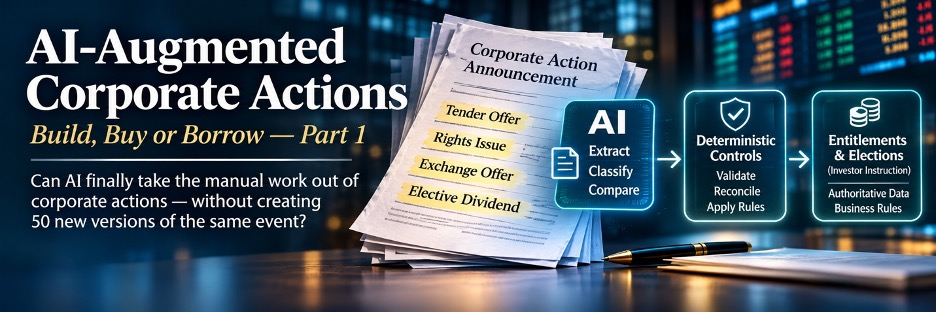
Corporate actions have always been a challenge for the financial services industry. A company announces a dividend, and brokers, custodians and back offices must reconcile the event terms against securities positions and investor entitlements. Over the past several decades, established processing platforms, including those provided by Broadridge, have industrialised much of the handling of straightforward mandatory events. Problem solved, then?
Um, not really.
ValueExchange research with DTCC puts the annual cost of US corporate actions processing at around $58 billion, roughly 0.05% of US market capitalisation [1]. That cost is spread across issuers, custodians, brokers and investors. DTCC estimates that standardised, golden-source event data could save $15 billion of it [3].
The part that never stopped being a chore is voluntary events: tender offers, rights issues, exchange offers, elective dividends. In each, the holder needs to make a decision, and that decision must travel back up a chain of intermediaries before a deadline. Upstream and downstream parties are rarely connected directly. By the time event information reaches the asset manager, it may have passed through six or seven hands. Like a game of broken telephone, the original event terms may not survive the journey [2]. Only about 4 in 10 voluntary events are processed straight-through [3].
Separately, around twenty years ago, Oxera ran a study sponsored by DTCC and conducted independently, putting the front-office risk from bad corporate action information at €1.6bn–€8bn a year. The same study found that a single complex event could expose one firm to tens of millions in back-office processing risk [4]. The STP figure says not much has changed since.
Standardising the processing of an event is not the same as standardising the announcement that created it. Between intermediaries, events now travel in structured messaging standards (ISO 15022 and ISO 20022). The problem sits upstream: the originating legal documents are unstructured, and turning them into an event is, in DTCC's words, "a fundamentally non-standard process" [2]. In a previous life, I dealt with these. An issuer offering a dividend reinvestment option might send a short email, or a letter, or put out a press release. It was never described the same way twice and didn't necessarily apply to every shareholder. Sometimes there was one announcement per share class; sometimes everything was lumped into one. The result was manually reviewing every announcement and keying what we'd read into the corporate actions system. No traditional processing system could handle that, and most still can't.
Now you're thinking: let the AI do it. Agentic extraction makes real sense here. The harder question is who builds it, who owns it, and who answers for it when it gets something wrong.
Keep in mind what's true of most agentic solutions. Working well in the demo is no guarantee it will work on every announcement. The model that performs beautifully in the pilot can fail the week after go-live because the newest announcement arrived in a form it has never seen. The design that survives that week keeps the model away from the entitlement entirely.
A production design needs source-grounded extraction, field-level provenance, event-data reconciliation, validation against independent authoritative sources where available, and exception handling.
An AI agent extracts, classifies and compares event terms. Deterministic controls validate those terms against authoritative event sources, reference data, positions and market rules. Validated event data and approved business rules determine entitlements and govern the processing of investor elections, subject to eligibility, deadlines and applicable market requirements. Unresolved discrepancies are escalated for qualified human review. The model proposes, and the controls dispose.
DTCC's own diagnosis makes the case for doing this carefully. Tim Lind describes a single legal event splintering into roughly 50 versions as it passes through six or seven intermediaries [2].
Used incorrectly, AI makes a 50-versions problem worse. If every firm downstream runs its own model over the same prospectus, you risk producing 50 fluent, apparently authoritative interpretations of the same legal event, with no guarantee that they agree.
Used correctly, the AI never becomes a source of truth. It extracts terms with a citation to the clause they came from, compares each version it receives against the issuer's agent or the CSD, flags where they diverge, and answers routine client inquiries from the authoritative record rather than from memory. Lind says clients put the cost of a single email inquiry at more than $50 [2], so that last use alone creates a measurable opportunity to reduce servicing costs.
Emerging provenance specifications, including the OASIS Data Provenance Standards work (draft specification 1.0, voting period underway), provide a framework for recording and tracing each version of an event back to its source [6]. [Transparency disclaimer: I am an active member of the OASIS Data Provenance Standards Technical Committee.]
So, three ways to get there.
Build. Use your own parsing team and your own golden-copy methodology, or license golden-copy data and process it yourself. You control everything past that, and you carry everything: maintaining market-by-market rules, monitoring the model as announcement formats drift, model risk documentation, and keeping the handful of people who actually understand the logic. Time to production is usually the longest of the three, though a large firm with an existing data team can close the gap. The risk sits entirely with you.
Buy. License a platform that provides golden copy, event management and election capture, or let your back-office provider or clearing firm run it. This usually shortens implementation, at the price of vendor lock-in. The integration with your books and records, and the configuration to your client base, are where the real cost lives. And buying doesn't buy your way out of accountability. FINRA has been explicit that outsourcing a function doesn't relieve a firm of its supervisory obligations [5].
Borrow. Specialist operations partners and fractional expertise who put an AI extraction and exception layer over the systems you already run. For a well-defined extraction-and-exception overlay, this can be the fastest route with the least capital committed, which is why it has become a serious option rather than a stopgap. For a custodian with complex legacy integrations, multiple markets or strict third-party risk requirements, that advantage erodes if a limited overlay isn't enough. The trade-offs are dependency on the partner and the discipline needed to bring the knowledge back in-house.
All of this circles back to governance. Deterministic controls are non-negotiable for entitlements, deadlines and client communications, whichever path you choose. The AI can read the announcement. It can't be the thing that decides what your client is owed.
The right path depends on your event volume, your mix of markets, and how much of the governance burden you are prepared to carry yourself.
CMA places experienced specialists where the problems are, and backs AI-enabled review with people accountable for every decision. Tell us your event volumes and market mix, and we'll tell you which path fits.
Next in the series: settlement fails, and why T+1 in the UK and EU in October 2027 is about to make them more expensive.
__________________________________________________________________________________________________________________________________________________________________________________________
Sources
ValueExchange / DTCC, Corporate Actions: A Team Sport, 2025. https://thevalueexchange.foleon.com/2025/corporate-actions-a-team-sport/a-corporate-action-costs-usd34-million-to-manage
DTCC, Taking Corporate Action: Q&A with Global Custodian (Tim Lind), 25 August 2025; first published by Global Custodian, 8 August 2025. https://www.dtcc.com/insights/2025/fireside-friday-with-dtccs-tim-lind
DTCC, The Cost of Corporate Actions, 2025. https://www.dtcc.com/teamsport
Oxera, Corporate action processing (sponsored by DTCC, independently conducted), 2004. https://www.oxera.com/wp-content/uploads/2018/03/Corporate-action-processing.pdf
FINRA, Regulatory Notice 21-29, Vendor Management and Outsourcing, 13 August 2021. https://www.finra.org/rules-guidance/notices/21-29
OASIS Data Provenance Standards Technical Committee, prov-meta 1.0 specification repository. https://github.com/oasis-tcs/dps